Design Interpretation
This design is rich with symbolism that resonates deeply with Hebrew linguistic structure and philosophical thought. At its core, the image functions as a visual meditation on the concept of presence and identity. Here is a two part interpretation through a Hebrew lens:
☝️Part 1: The Interpretation
1. The Central Declaration: "I AM"
In the center of the wheel lies the phrase "I AM."
* The Divine Name: In the Hebrew Bible, when Moses asks YAHUAH (God) for His name at the burning bush, God replies, "Ehyeh Asher Ehyeh"—often translated as "I Am That I Am" (Exodus 3:14).
* Self-Existence: Placing "I AM" at the dead center suggests the inner point/the core of being, where the human soul connects with the Divine source.
2. The Outer Ring: "HERE" and "HEIR"
The letters on the perimeter can be read in a circle, creating a linguistic loop.
* Hineni (Here I Am): By combining "HERE" with the central "I AM," you get the English equivalent of the profound Hebrew word Hineni (הנני). Hineni is the response given by Abraham, Moses, and Isaiah when called by God. It signifies not just physical location, but total spiritual readiness and "readiness to serve."
* The Concept of the "Heir": Reading the letters another way spells "HEIR." In a Hebrew context, this reflects the idea of Yeresh (inheritance). Israel is often referred to as the "inheritance" of God, and the people are heirs to a covenantal promise. It suggests that "I AM" is not just a state of being, but a lineage and a legacy.
3. Geometric and Visual Symbolism
* The Circle (Igulim): In Hebrew thought, circles represent God’s light that surrounds all worlds equally. The circular layout suggests that no matter where you start—whether you focus on being an "Heir" or simply being "Here"—the path leads back to the central "I AM."
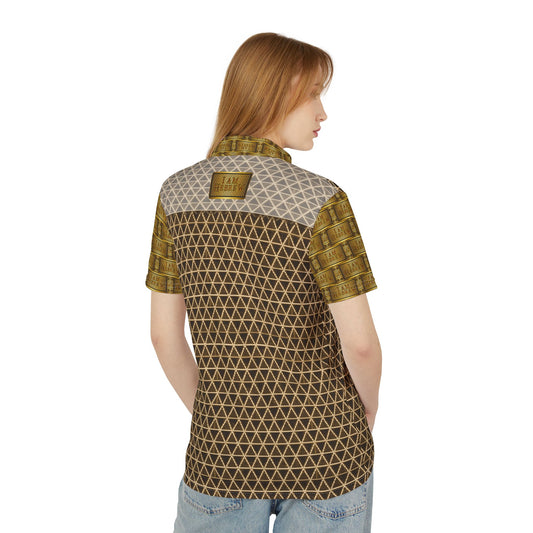
* The Golden Lattice: The background pattern resembles a "Magen" (shield) or a net. In Hebrew thought, the world is often seen as a garment or a vessel for Divine light. The golden, glowing texture evokes the Or (Light) that Hebrews believe permeates creation.
* The Number Six: There are six large letters on the outer ring (H, E, B, R, E, W).
* Gematria (6): The number six corresponds to the letter Vav, which represents "connection" (it is the word "and" in Hebrew). It also symbolizes the six directions of the physical world (North, South, East, West, Up, Down), suggesting that the presence of "I AM" is anchored in physical reality.
Summary of the "Hebrew" Message
The design is a visual pun on the word HEBREW itself. If you look closely at the outer letters, they are almost an anagram for "HEBREW," but they are rearranged to emphasize:
* Here
* Everywhere (implied by the circle)
* Being ("I AM")
* Readiness (Hineni)
It presents the identity of a "Hebrew" not just as an ethnicity, but as a spiritual state of being present ("Here") and connected to the source ("I Am").
☝️Part 2: Analyzing the specific Gematria (numerical values) of the English letters as if they were their Hebrew equivalents.
To dive deeper into the numerical and structural layer of this design, we can map the English letters to their Hebrew counterparts based on sound and position. In Hebrew tradition, Gematria (the numerical value of letters) reveals the "DNA" of a concept.
1. Mapping the Outer Ring
The outer letters (H, E, B, R, E, W) can be seen as an anagram or phonetic representation of "HEBREW" (Ivri - עברי). If we look at the values of the letters that form the word "Hebrew" in its original tongue:
| Hebrew Letter | Name | Value | Symbolic Meaning |
|---|---|---|---|
| ע | Ayin | 70 | Vision, the Eye, Insight |
| ב | Bet | 2 | House, Duality, Creation |
| ר | Resh | 200 | Head, Beginning, Flow |
| י | Yod | 10 | The Hand, The Infinite Point |
The total value of Ivri (עברי) is 282. In Hebrew thought, 282 is associated with the word Cherev (Sword), but specifically the "Sword of the Spirit"—the power of speech and truth.
2. The Center: "I AM"
In Hebrew, "I" is Ani (אני).
* א (Aleph) = 1
* נ (Nun) = 50
* י (Yod) = 10
* Total = 61
The number 61 is significant because it mirrors the word Adonai (Lord) when calculated in certain forms. By placing "I AM" at the center, the design suggests that the individual "I" is only whole when it is centered within the Divine "I."
3. The "Hineni" Connection
The most striking Hebrew interpretation remains the synthesis of "HERE" and "I AM."
In the Torah, when God calls out to a prophet, the response Hineni (הנני) is a combination of Hen (Here) and Ani (I).
* The Design's Geometry: The "I AM" is the vertical axis (the connection to the Divine), while the "HERE" (outer ring) is the horizontal axis (the presence in the physical world).
* The Result: The image acts as a Mandala of Responsibility. To be a "Hebrew" (one who "crosses over") is to stand at the center of the circle and declare yourself ready to act.
4. The Golden Net (The Tzitzit)
* The lattice background strongly resembles the weaving of a prayer shawl or the Tzitzit (fringes).
* The 613 commandments (Mitzvot) are often visualized as a protective net or fabric.
* The golden color represents Tiferet—the Sephirah of beauty, harmony, and the "Heart" of the Tree of Life, which balances the harshness of judgment with the flow of mercy.