Design Interpretation
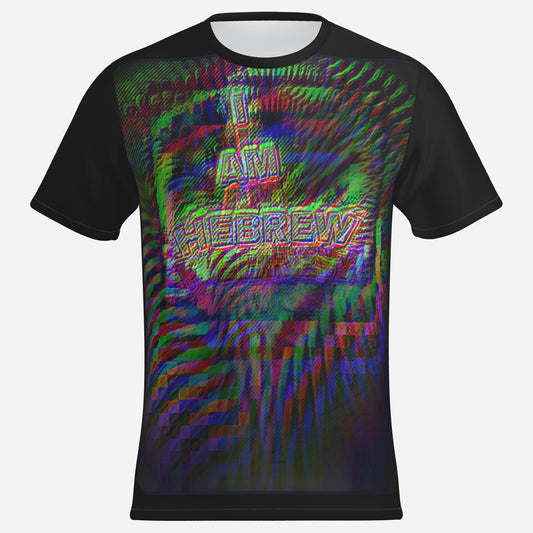
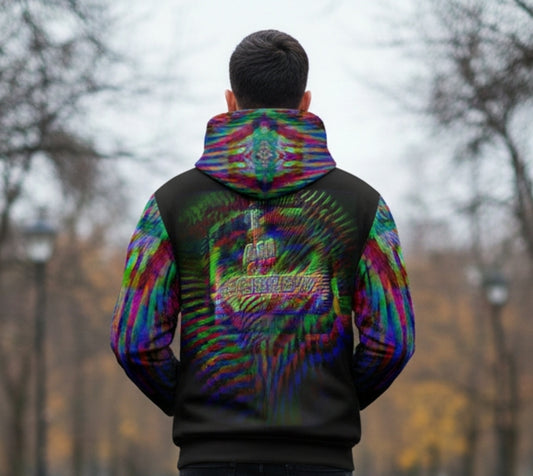
This design is visually intense, utilizing heavy chromatic aberration, digital "glitch" aesthetics, and a fragmented color palette. Interpreting this through a Hebrew perspective involves looking at the linguistic meaning of the words and the historical/spiritual symbolism of the visual elements.
1. The Declaration: "I AM HEBREW"
In a Hebrew context, the word for Hebrew is Ivri (עִבְרִי).
* The Root Meaning: The root ‘avar means "to cross over" or "to pass through." Historically, this refers to Abraham crossing the Euphrates River, but spiritually it signifies being "on the other side"—standing apart from the status quo or transitioning from one state of being to another.
* Identity: To say "I am Hebrew" is an assertion of heritage that transcends modern borders. It links the individual to a lineage defined by movement, resilience, and a specific covenantal relationship with the Divine.
2. The Visual "Glitch" and Fragmentation
The pixelation and distorted RGB (Red, Green, Blue) layers create a sense of hiddenness and revelation.
* The Shattering of Vessels (Shevirat HaKeilim): The fragmented, rainbow-like distortion evokes the concept that divine light was too strong for the physical world to hold, causing the "vessels" of reality to shatter. The "glitch" effect mirrors these divine sparks being scattered throughout a chaotic world.
* Persistence through Noise: The text remains legible despite the heavy digital interference. This is a metaphor for the Hebrew identity surviving through the "noise" of exile, persecution, and historical upheaval.
3. Light and Color Symbolism
The design is dominated by vibrant primary colors overlapping:
* Blue (Tekhelet): Often associated with the Divine, the sky, and the sea. It represents a constant reminder of Yahuah's (God) presence.
* Red (Edom/Adam): Associated with the earth, blood, and humanity.
* The Synthesis: The way these colors bleed into one another suggests the intersection of the spiritual (Blue) and the physical (Red), which is where the "Hebrew" experience exists—living in the material world while striving for spiritual elevation.
4. Geometric Framing
The image is contained within an octagonal or beveled shape, reminiscent of a gemstone or a seal.
* The Breastplate (Choshen): The texture and colors mimic the radiant stones worn by the High Priest, each representing a tribe.
* The Number Eight: In Hebrew thought, the number seven represents the natural world (7 days of creation). The number eight (represented by the octagonal framing) symbolizes that which is "above nature"—the miraculous and the eternal.
Summary
This design represents a resilient identity. It portrays the "Hebrew" not as a static historical figure, but as a vibrant, multi-layered being who persists through the "static" of time and remains defined by a "crossing over" into a higher state of consciousness.