Collection: Hebrew World (01-01): The Radiant Six
Design Interpretation
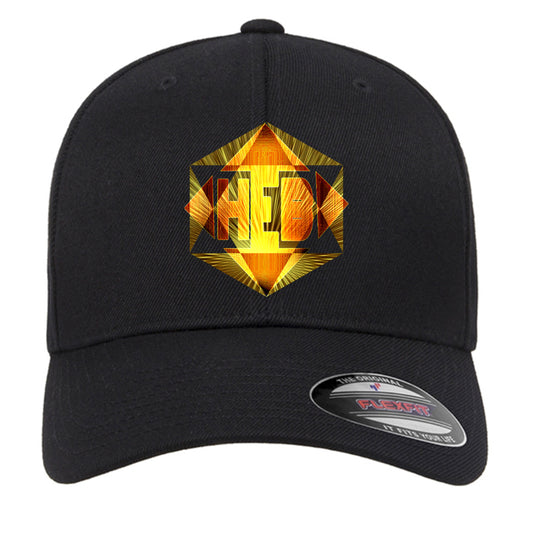
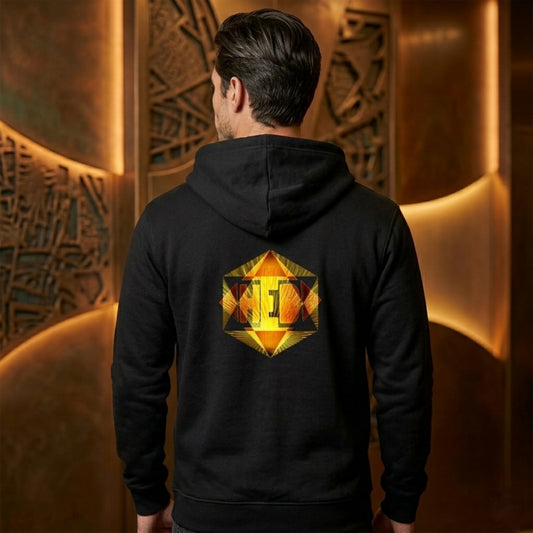
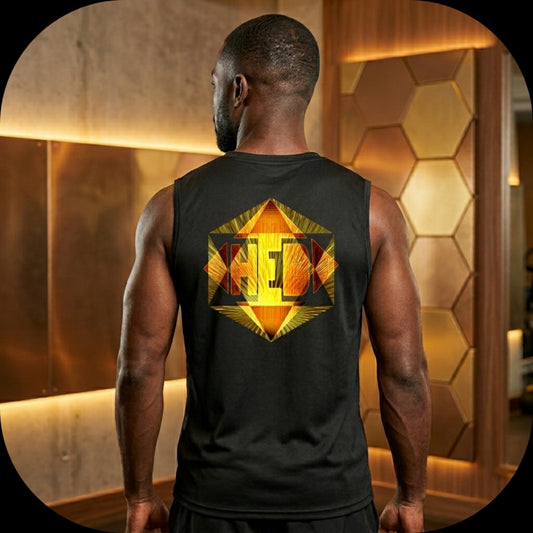
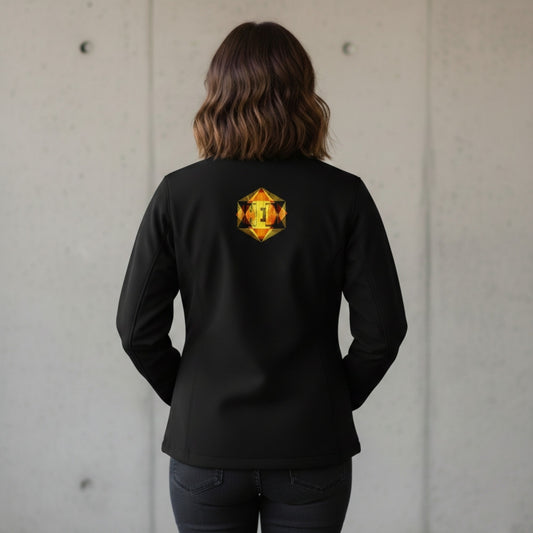
To interpret this design through a Hebrew perspective, we can look at the interplay of the central lettering, the geometry, and the symbolic use of light and color.
The design carries a heavy "Merkabah" (Chariot) or "Throne Room" aesthetic, reminiscent of the visions found in the book of Ezekiel.
1. The Central Text: "HEB"
While "HEB" is a common abbreviation for "Hebrew," the visual treatment adds deeper layers:
-
The Pillar: The central "E" is elongated, acting as a vertical axis. In Hebrew thought, this reflects the Sefirot or the "Middle Column" of the Tree of Life—representing balance (Tiferet) between justice and mercy.
-
Letter Geometry: The blocky, golden structure of the letters mimics the Luchot HaBerit (the Tablets of the Covenant). It suggests that the word itself is a foundational, architectural force.
2. The Geometric Framework
The design is built on a series of nested shapes that hold significant meaning:
-
The Hexagon: This is the outer boundary of the Magen David (Star of David). It represents the six directions of the physical world (North, South, East, West, Up, Down) all unified by a central point—the Divine.
-
The Four Arrows: Notice the triangles pointing Up, Down, Left, and Right.
- This mirrors the four faces of the Chayot (living creatures) in Ezekiel's vision.
- It also suggests the concept of Hodu (thanksgiving), where one acknowledges God's presence in every direction of the compass.
3. Light, Gold, and Fire
The color palette is dominated by amber and gold, colors specifically associated with the Divine presence:
-
Chashmal: In Ezekiel 1:4, the prophet describes a "glowing metal" or "electrum" (Chashmal). This design’s metallic, radiating texture captures this "brilliance" perfectly.
-
Or Ganuz (The Hidden Light): The way the light streaks outward from the center suggests the primordial light created on the first day, which Hebrew tradition says was "hidden away" for the righteous to see the world from one end to the other.
4. Technical Symbolism: The "Circuitry"
If you look closely at the texture of the letters, there is a pattern resembling computer chips or circuitry.
-
Modern Midrash: This can be interpreted as the Torah as the "Source Code" of the universe. Just as code runs a program, Hebrew letters are traditionally viewed as the building blocks (the "DNA") through which the world was spoken into existence.
Summary: This design feels like a "digital Tabernacle." It represents the idea that the Hebrew identity/language is a radiant, multidimensional structure that connects the physical directions of the world to a high, golden source.