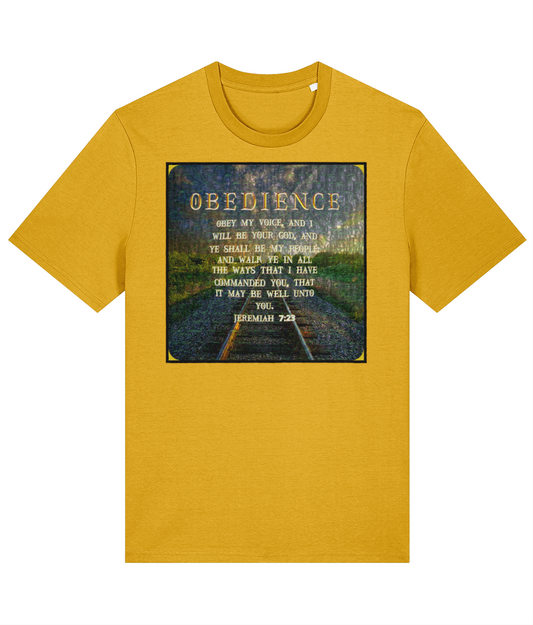
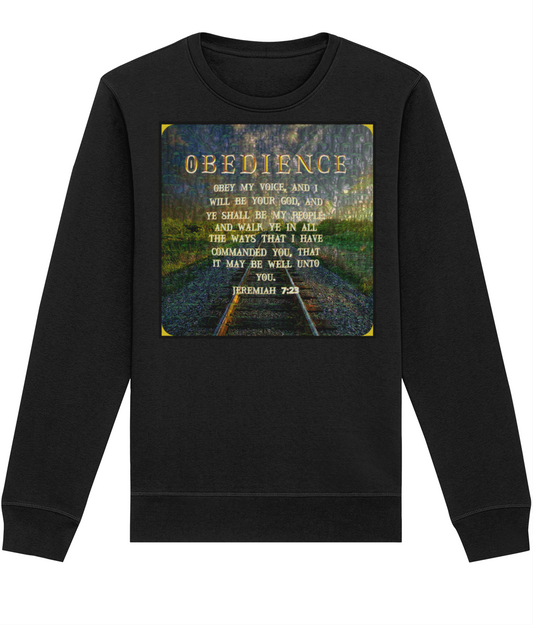
This design features the text of Jeremiah 7:23 set against a backdrop of railway tracks leading into a complex, patterned horizon. Interpreting this through a Hebrew lens reveals deep layers of meaning regarding the relationship between the Creator and humanity. In a Hebrew context, "Obedience" is not merely about submission, but about relationship, movement, and hearing.
1. The Concept of Shema (Hearing/Obedience)
In the Hebrew Bible, there is no separate word for "obey." The word used is Shema (שְׁמַע), which means to hear, to listen, and to take action simultaneously.
* The Voice: The text "Obey my voice" (Sh'mu b'qoli) implies a dynamic, living relationship rather than just following a written code. In Hebrew thought, the "voice" of Yahuah (God) is the sustaining force of creation.
* The Promise: The phrase "I will be your God, and ye shall be my people" reflects the Covenant (Berit). This is the central theme of the Hebrew perspective—a formal, binding relationship based on mutual commitment.
2. The Imagery of the Way (Halakhah)
The railway tracks in the image provide a powerful visual metaphor for the Hebrew concept of Halakhah (walking).
* Walking vs. Moving: While the tracks suggest a modern "train," the text says "Walk ye in all the ways." Halakhah comes from the root halak (to walk). It represents the practical application of divine instructions in daily life. In Hebrew thought, faith is not a static state of mind; it is a direction. One "walks" in the commandments.
* The Path: The tracks represent a set path. In Hebrew thought, the "Way" is not a restriction of freedom but a guide that ensures one reaches the destination safely. Just as a train is "free" only when it stays on the tracks, a person finds true "wellness" (it may be well unto you) by staying within the parameters of divine wisdom. The tracks represent a defined, set path. While the surroundings (the world) are lush and perhaps distracting, the tracks provide the structural integrity needed to move forward toward a destination.
3. The Covenantal Promise
The heart of the verse—"I will be your God, and ye shall be my people"—is the classic formula of the Covenant (Brit).
* Reciprocity: The image shows the tracks and the landscape merging. This reflects the Hebrew idea that when the people align their "walk" with the Divine "voice," the relationship becomes harmonious.
* Blessing: The phrase "That it may be well unto you" highlights that the commandments (Mitzvot) are not viewed as burdens, but as a system of "spiritual hygiene" or "instructions for living" designed for human flourishing.
4. The Symbolism of the Circle and Square Frames
* The Enclosure: The circular and square frames suggests the Hebrew concept of Sovev (encompassing). They represent God’s protection and the idea that His presence surrounds the believer.
5. The Goal: Shalom and Wellness
The verse ends with "that it may be well unto you." In Hebrew, this "wellness" is tied to Shalom.
* Wholeness: Shalom is not just the absence of conflict; it is completeness, health, and prosperity.
* Cause and Effect: This design illustrates a linear progression—starting with the "Voice," walking the "Way," and ending in a horizon of light. It suggests that obedience is the mechanism that triggers the state of Shalom.
Summary Table
| Element | Hebrew Concept | Meaning |
|---|---|---|
| Obedience | Shema | To listen with the intent to act. |
| Railway Tracks | Halakhah | The "walk" or lifestyle of following the path. |
| The Horizon | Tikvah | Hope/Expectation of a good future (Acharit). |
| The Circle & Square Frames | Kav / Igul | Divine boundary and encompassing protection. |