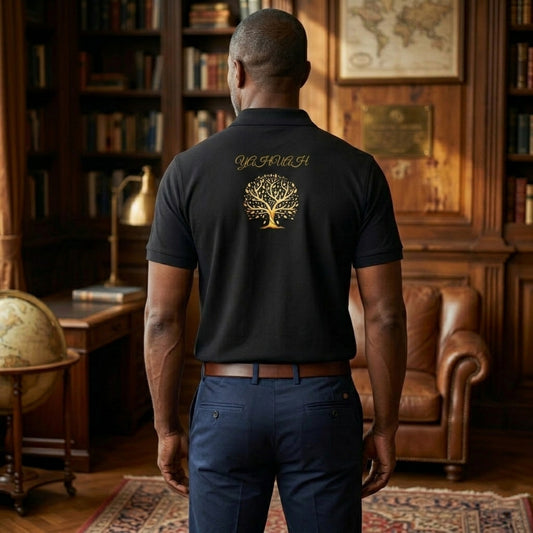
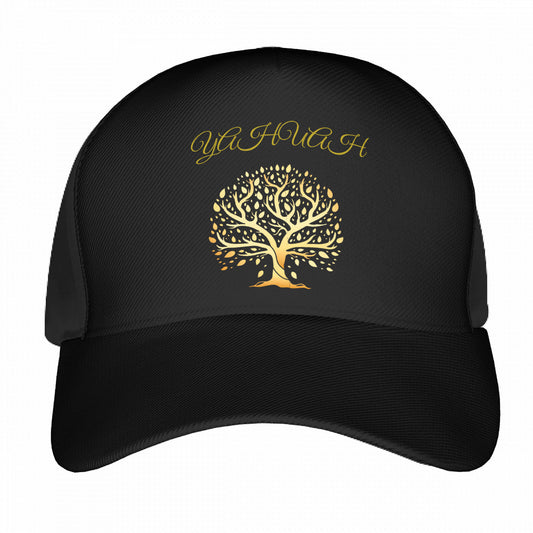
Yahuah: Tree of Life (01-01)
Design Interpretation
This design is a masterclass in Sacred Minimalist aesthetic, merging spiritual nomenclature with universal iconography. It serves as a sacred emblem for those returning to "Hebrew Roots," emphasizing a direct, life-giving connection to the Creator.
1. Color Palette & Art Style
The design utilizes a high-contrast "Celestial Gold on Onyx" palette.
-
The Palette: A sophisticated gradient of Luminous Gold, Burnished Amber, and Deep Bronze set against a Pure Black (#000000) background.
-
Art Style: The style is Modern Symbolic Realism. It uses clean, vector-style lines paired with soft inner glows and outer emanations to create a three-dimensional "light-source" effect. The black background acts as a "void," making the golden elements appear as if they are self-illuminating.
2. The Name: "YAHUAH"
At the apex is the name YAHUAH (the transliterated Tetragrammaton, $YHWH$) rendered in a refined, Calligraphic Script.
-
Significance: This specific spelling is central to the "Set-Apart" movement, focusing on the original phonetic Hebrew pronunciation of the Creator.
-
Styling: The cursive font and golden radiance suggest divine royalty and the concept of Or (Light). The fluid strokes reflect the "living" nature of the name.
3. The Icon: The Tree of Life
Below the name sits a sprawling, intricate tree—an ancient symbol of life and sustenance.
-
Biblical Connection: Represents the Tree of Life from Genesis to Revelation, symbolizing eternal life and the physical manifestation of Divine presence.
-
Growth & Connectivity: The interlocking branches represent the "grafting in" of believers and the bridge between the earthly and the heavenly realms.
-
Gradient Sophistication: The transition from bright gold at the crown to deeper bronze at the roots symbolizes refinement—the process of being tried in fire and emerging as pure gold.
4. Visual Composition & Intent
-
Radial Symmetry: The centered, balanced composition evokes Divine Proportion and a sense of cosmic order.
-
The Glow/Aura: A soft, ethereal blur surrounds the text and foliage. This "Shekhinah" effect suggests that the image is not a static object, but an emanation of spiritual energy.
Summary: Through its intentional use of golden gradients and sacred geometry, this design communicates a message of spiritual groundedness and the radiant glory of YAHUAH.
Yahuah: Tree of Life (01-02) - Royal Raiment
Design Interpretation
In a Hebrew context—grounded in the Tanakh and the Paleo-Hebrew perspective—the Royal Raiment becomes a visual tapestry of sovereignty, life, and the celestial order.
The Symbol: The Golden Tree (Etz Chayim)
The symbol on the left chest represents the Etz Chayim (Tree of Life). Placed over the heart, it serves as a "seal" of the Covenant.
-
The Foundation: In Hebrew thought, a tree represents the Torah or the Divine Wisdom of Yahuah. As it is written, "She is a tree of life to those who lay hold of her." It symbolizes a life rooted in truth and branching toward the heavens.
-
The Gold Finish: Gold represents the "Refiner’s Fire" and the incorruptible nature of the Creator. It signifies that which is set apart (Kodesh) and of the highest value within the Kingdom.
-
The Name: The name Yahuah (the Tetragrammaton) placed above the tree establishes ownership and authority. It signifies that the life depicted here is sustained specifically by the Breath (Ruach) of the Father.
The Colors: The Celestial Spectrum
The transition from deep purples to vibrant blues and magentas on the sleeves reflects the "Colors of the Tabernacle" (Mishkan) and the heavens (Shamayim).
-
Royal Purple (Argaman): Historically the most expensive dye, derived from the sea. In a Hebrew perspective, this is the color of Kingship. It represents the bridge between the earthly and the divine, signaling that the wearer is part of a "Kingdom of Priests."
-
Deep Blue (Tekhelet): This specific shade is deeply significant in the fringes (Tzitzit) of Hebrew garments. It represents the Throne of Glory and the sapphire pavement mentioned in the visions of the prophets. It serves as a constant reminder of the Law and the heavenly origin of the soul.
-
Crimson/Magenta (Tola’at Shani): This represents the life force and the blood of the Covenant. It is the color of sacrifice and redemption, grounding the higher blues and purples in the reality of life and vitality.
The Transition: "Liquid Light"
The "Liquid Light" flow on the sleeves suggests the Living Waters (Mayim Chayim). In Hebrew thought, light and water are often synonymous with the outpouring of wisdom. The way the colors bleed into one another mimics the Rainbow (Qeshet)—the sign of the eternal promise and the multi-faceted nature of the Creator's favor.